August 25, 2026 | By Admin
Shadow Planets in Jyotish: Their Meaning and Influence
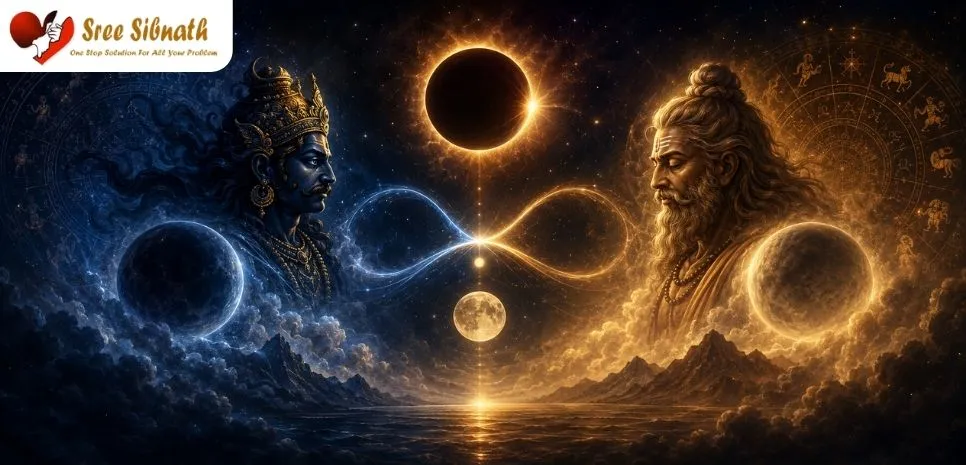
Some forces in astrology are easy to notice, and some work quietly beneath the surface. Rahu and Ketu belong to the second category. Known as the shadow planets in Vedic astrology, they are not physical planets. They are actually the north and south lunar nodes, the points where the Moon’s orbit intersects the ecliptic.
Their symbolism denotes desire, detachment, confusion, transformation, and spiritual growth. In this blog, we will highlight the meaning of Rahu and Ketu in astrology and their traditional influence. We will also explore why astrologers pay special attention to their position when seeking love problem solution in India.
Rahu and Ketu in Vedic Astrology
We all know that planetary positions form an important part of a birth chart. However, Rahu and Ketu always maintain positions exactly opposite to each other. In Vedic astrology, they form an axis that astrologers interpret as an important area of life experience and development.
- Rahu: The Force of Desire and Ambition
The first shadow planet that represents the north lunar node is Rahu. In traditional Jyotish interpretations, Rahu signals strong desires, ambition, curiosity, and attraction toward unfamiliar experiences.
Rahu can encourage a person to explore new paths, take risks, and move beyond conventional boundaries. At the same time, its symbolism can point toward confusion, excessive attachment, or an endless desire for more. Its results depend greatly on the house, sign, and other planetary influences in a birth chart.
- Ketu: Detachment and Inner Awareness
Ketu is another shadow planet that represents the south lunar node. Ketu is traditionally associated with detachment, introspection, spirituality, and letting go.
Ketu may indicate areas where a person feels naturally comfortable or less interested in worldly recognition. Astrologers often interpret Ketu as a force that encourages deeper reflection and a search for meaning beyond material achievement.
The Rahu-Ketu Cycle
Do you know why Kolkata’s best astrologer study Rahu and Ketu together? They always remain approximately 180 degrees apart in the zodiac. Therefore, one cannot properly understand the impact of one node without considering the other.
The Rahu-Ketu cycle is known as a balance between desire and detachment. Rahu pulls attention toward new experiences. Ketu, on the other hand, represents areas where one may need to release excessive attachment.
Their Connection with Eclipses
The astronomical foundation behind Rahu and Ketu is fascinating. The lunar nodes are the points where the orbital path of the Moon crosses the ecliptic. Solar and lunar eclipses take place when the Sun and Moon align near these nodes.
This connection helped shape the powerful mythology surrounding Rahu and Ketu in Indian tradition. The well-known story describes Rahu and Ketu as the separated head and body of the asura Svarbhanu. According to the mythology, this happened after he attempted to consume the nectar of immortality.
Why Their Birth-Chart Position Matters
In Vedic astrology, astrologers examine the house, zodiac sign, nakshatra, conjunctions, and planetary aspects involving Rahu and Ketu. Their interpretation can therefore vary considerably from one horoscope to another.
Instead of viewing Rahu or Ketu as simply “good” or “bad,” a complete chart analysis considers the wider planetary pattern. This approach can provide a more balanced understanding of their traditional symbolism.
FAQs
Why are Rahu and Ketu called shadow planets?
Rahu and Ketu are not physical planets like Mars or Jupiter. They are mathematical points where the Moon’s path crosses the Sun’s apparent path. Vedic astrology still gives these lunar nodes a strong symbolic role.
What happens when Rahu becomes prominent in a horoscope?
A strong Rahu denotes ambition, curiosity, sudden changes, and a desire to experience something beyond the familiar. Its influence can vary depending on its house, sign, and relationship with other planets.
How can I understand Ketu’s influence in my horoscope?
You can seek guidance from a reputable and experienced astrologer who can study Ketu’s placement along with the other planetary positions in your birth chart. A complete reading can offer a more balanced understanding of its traditional influence on your life.
Can Rahu and Ketu affect career and relationships?
Astrologers may consider their placement when studying career, relationships, and other life areas. However, they do not interpret Rahu or Ketu alone. The complete birth chart provides the broader picture.
The Conclusion
Rahu and Ketu represent one of the most intriguing concepts in Vedic astrology. You can understand their influence through themes of ambition, uncertainty, detachment, transformation, and inner growth. However, it’s important to interpret their meaning within the complete birth chart instead of isolated predictions. If you want to explore the deeper significance of Rahu, Ketu, and other planetary influences, connect with Sree Sibnath today. Search for the term ‘aghori tantrik near me’ and let the wisdom of astrology help you look at life’s uncertainties with greater clarity and confidence.


 Online chat