October 5, 2026 | By Admin
Lagna vs Rashi: How Are They Different in Vedic Astrology?
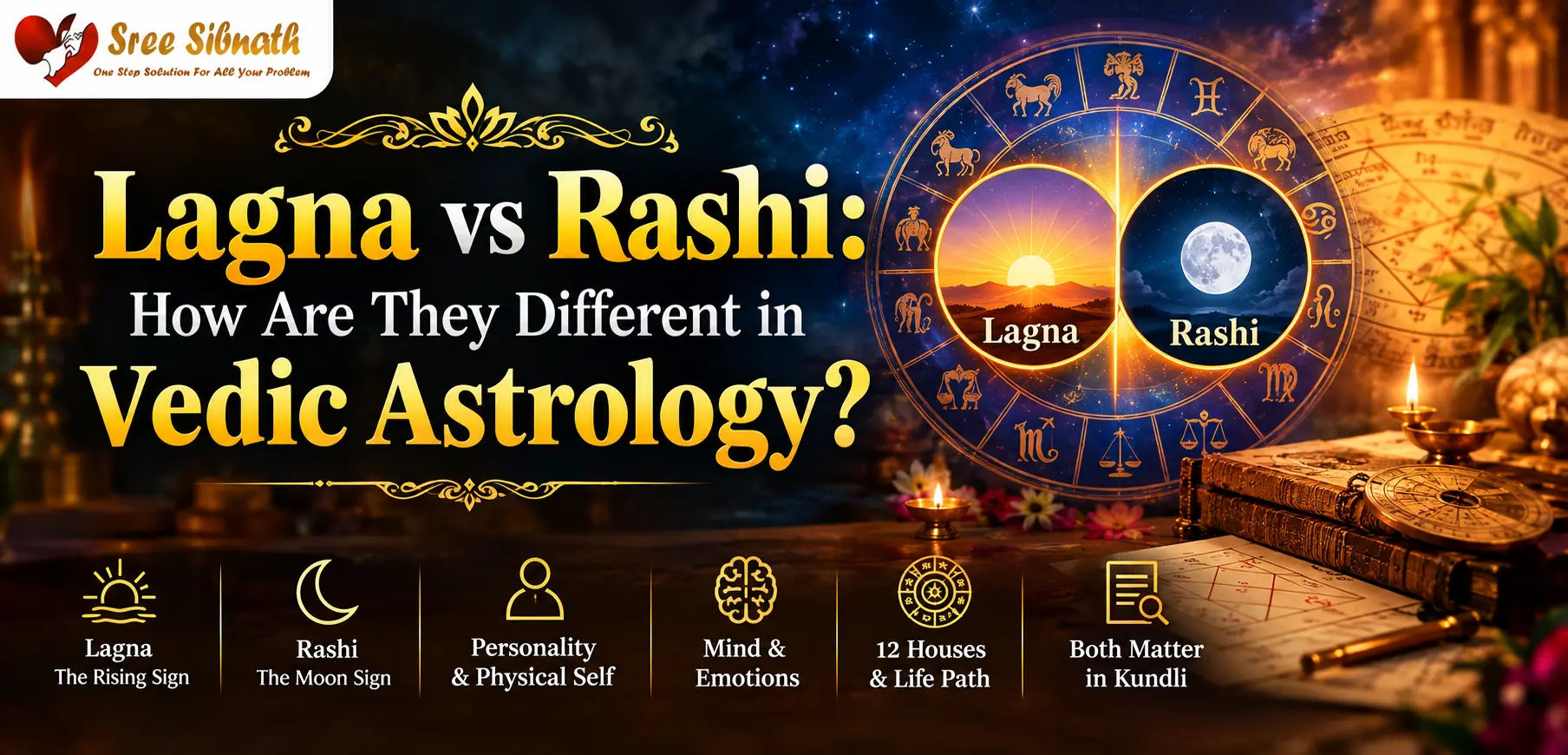
A birth chart does not tell just one story. It has different points that reveal different sides of a person’s life. Two of the most important among them are Lagna and Rashi. Many people use these terms as if they mean the same thing. However, they are very different. In Vedic astrology, Lagna refers to the Ascendant, while Rashi usually refers to the Moon sign.
Each has a different role in Kundli reading and prediction. Do you know why two people with the same Rashi can still have very different personalities and life experiences? It’s because their Lagnas may differ. In this blog, we will highlight the key differences between Lagna and Rashi and understand why both matter in Vedic astrology.
What is Lagna in Vedic Astrology?
Lagna is the zodiac sign that appears on the eastern horizon at the accurate time and place of birth. Reputable astrologer in Kolkata also call it the Ascendant or Rising Sign. Since the Ascendant changes roughly every two hours, an accurate birth time plays an important role in finding it.
Lagna forms the foundation of the birth chart. Astrologers count the 12 houses from the Lagna when making predictions. These houses help them study areas such as personality, health, career, relationships, wealth, and family life. Lagna in a birth chart represents the following aspects.
- Physical appearance and body
- Personality and natural behavior
- Approach towards life
- Physical vitality
- General life direction
What is Rashi in Vedic Astrology?
Rashi usually means Janma Rashi or Moon Sign in Indian astrology. It shows the zodiac sign where the Moon was located at the time of birth. The Moon moves much faster than the Ascendant and changes signs in about two to three days.
Rashi mainly helps astrologers understand the mind and emotional side of a person. It also plays an important role in reading Nakshatra, Dashas, and certain predictive systems. Rashi in a birth chart represents:
- Mind and emotions
- Feelings and instincts
- Mental patterns
- Habits and responses
- Emotional experiences
Lagna vs Rashi: Key Differences
The easiest way to understand the difference is to think of Lagna as the outer self and Rashi as the inner emotional self. Lagna shows the Ascendant, which forms the starting point of the 12 houses in a Kundli. It depends heavily on the exact time and place of birth. Since the Ascendant moves quickly, Lagna can change roughly every two hours. It helps astrologers understand a person’s personality, physical nature, and overall approach to life.
Rashi usually refers to the Moon sign. It shows the zodiac sign where the Moon was placed at the time of birth. Unlike Lagna, Rashi changes every two to three days as the Moon moves through the zodiac. It gives insight into a person’s mind, emotions, habits, and mental patterns. Astrologers and tantrik in Kolkata consider Rashi when studying emotional responses and inner experiences.
Both Lagna and Rashi provide valuable information in Vedic astrology. Lagna creates the basic structure of the birth chart, while Rashi adds depth to the emotional and mental picture. Therefore, an astrologer should not replace one with the other when studying a complete Kundli. Looking at both can provide a more balanced understanding of a person’s nature and life path.
Which is More Important: Lagna or Rashi?
This question has no simple one-word answer. Lagna and Rashi serve different purposes. Lagna provides the framework of the birth chart, while Rashi offers important insight into the Moon and the mind.
For a detailed Vedic astrology reading, an astrologer generally considers both planetary positions, houses, Nakshatra, Dashas, and other chart factors. Hence, looking at only Lagna or only Rashi can give an incomplete picture.
FAQs
- Is Rashi the same as Lagna?
No. Rashi usually means Moon sign, while Lagna means Ascendant.
- Can my Lagna and Rashi be different?
Yes. Your Lagna and Rashi can fall in different zodiac signs.
- Which one needs an exact birth time?
Lagna needs an accurate birth time and place because the Ascendant changes quickly.
The Conclusion
In summary, understanding Lagna vs Rashi can make Vedic astrology much easier to follow. Lagna helps describe the physical self and the structure of the birth chart. Rashi gives deeper insight into the mind and emotional nature. Together, they provide a broader foundation for Kundli analysis.
If you want to understand your birth chart and seek effective love problem solution in Kolkata, Sree Sibnath can offer astrology and traditional spiritual consultation services. With experience in astrology and Tantra, Sree Sibnath provides individual guidance based on each person’s concerns. So, explore the astrology services of Sree Sibnath to understand your Kundli with greater clarity and make more informed choices.


 Online chat